> ## Documentation Index
> Fetch the complete documentation index at: https://docs.hub2.io/llms.txt
> Use this file to discover all available pages before exploring further.
# Refunds
# Lifecycle
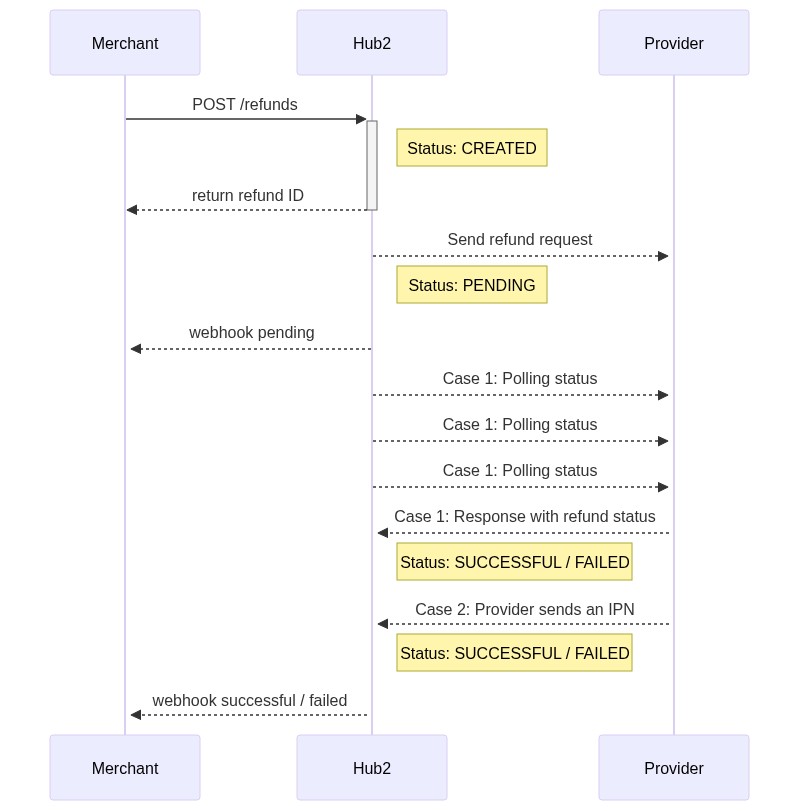
To help getting started with the Refunds API, this illustration shows off how refunds are handled by HUB2 API.
 # API Reference
The *Refunds API* allows merchants to initiate refunds for previously successful transfers.
* [Refunds](#refunds)
* [Creating a refund](#creating-a-refund)
* [Restrictions](#restrictions)
* [Retrieving refund details](#retrieving-refund-details)
* [List refunds](#list-refunds)
* [Pagination](#pagination)
***
## Creating a refund
[HUB2 API reference - Create a refund](/api-reference/refunds/create-refund)
Creating a refund requires one call to the dedicated endpoint with the transfer ID that you want to refund.
Sample request :
```bash Curl theme={null}
curl --location --request POST 'https://api.hub2.io/refunds' \
--header 'ApiKey: [REDACTED]' \
--header 'MerchantId: [REDACTED]' \
--header 'Environment: sandbox' \
--header 'Content-Type: application/json' \
--data-raw '{
"id": "tr_000000000000000000011",
"zendeskTicketId": "zd_123456"
}'
```
```typescript Typescript theme={null}
import fetch from 'node-fetch';
async function createRefund() {
const response = await fetch('https://api.hub2.io/refunds', {
method: 'POST',
headers: {
'ApiKey': '[REDACTED]',
'MerchantId': '[REDACTED]',
'Environment': 'sandbox',
'Content-Type': 'application/json'
},
body: JSON.stringify({
"id": "tr_000000000000000000011",
"zendeskTicketId": "zd_123456"
})
});
if (response.ok) {
const result = await response.json();
console.log(result);
} else {
console.log(`HTTP Status: ${response.status}`);
}
}
createRefund();
```
```python Python theme={null}
import json
import requests
headers = {
'ApiKey': '[REDACTED]',
'MerchantId': '[REDACTED]',
'Environment': 'sandbox',
'Content-Type': 'application/json',
}
data = {
"id": "tr_000000000000000000011",
"zendeskTicketId": "zd_123456"
}
response = requests.post(
'https://api.hub2.io/refunds',
headers=headers,
data=json.dumps(data)
)
if response.status_code == 200:
print(response.json())
else:
print(f'HTTP Status: {response.status_code}')
```
This request will initiate a refund for the specified transfer. The refund will be processed asynchronously and you will receive webhooks notifications about the status changes.
For any ticket to HUB2 support team concerning a refund, the refund ID will be asked, not the transfer ID.
### Restrictions
* Only successful transfers can be refunded
* A transfer can only be refunded once
* The refund amount will be the full amount of the original transfer
***
## Retrieving refund details
[HUB2 API reference - Get refund details](/api-reference/refunds/retrieve-a-refund)
To retrieve a refund, perform a call to the dedicated endpoint. *Note : This endpoint requires a refund ID, obtained when creating a refund ([see previous step](#creating-a-refund)).*
This endpoint was designed to get the full details of a refund, including its current status and processing information.
***This endpoint***, like every endpoint on HUB2 API, ***is rate limited***. That means that if this endpoint is called too many times by a merchant ID, the HUB2 API will respond with `HTTP 429 Too Many Requests` to that merchant ID.
Documentation about rate limits [can be found here](/documentation/en/limits).
Sample request :
```bash Curl theme={null}
curl --location --request GET 'https://api.hub2.io/refunds/123' \
--header 'ApiKey: [REDACTED]' \
--header 'MerchantId: [REDACTED]' \
--header 'Environment: sandbox' \
--header 'Content-Type: application/json' \
```
```typescript Typescript theme={null}
import fetch from 'node-fetch';
async function getRefund() {
const response = await fetch('https://api.hub2.io/refunds/123', {
method: 'GET',
headers: {
'ApiKey': '[REDACTED]',
'MerchantId': '[REDACTED]',
'Environment': 'sandbox',
'Content-Type': 'application/json'
}
});
if (response.ok) {
const refund = await response.json();
console.log(refund);
} else {
console.log(`HTTP Status: ${response.status}`);
}
}
getRefund();
```
```python Python theme={null}
import requests
headers = {
'ApiKey': '[REDACTED]',
'MerchantId': '[REDACTED]',
'Environment': 'sandbox',
'Content-Type': 'application/json',
}
response = requests.get(
'https://api.hub2.io/refunds/123',
headers=headers
)
if response.status_code == 200:
print(response.json())
else:
print(f'HTTP Status: {response.status_code}')
```
Once a Refund has been created and webhooks have been configured to receive notifications about the Refund's lifecycle, HUB2 will send webhooks for each event associated with configured webhooks.
**This is the recommended method for taking into account changes in the status of a Refund.** Some Refunds are processed quickly, while others less so, for a variety of unforeseeable reasons. There is no point in retrieving the details of a Refund to retrieve the status of a Refund if no change has taken place. This is why setting up webhooks is recommended.
Documentation about webhooks [can be found here](/integration/en/webhooks/webhooks_overview).
***
## List refunds
[HUB2 API reference - List refunds](/api-reference/refunds/retrieve-refunds-collection)
To fetch a list of refunds, use the dedicated endpoint. Several query parameters (see below) can be applied to filter our results.
Sample request :
```bash Curl theme={null}
curl --location --request GET 'https://api.hub2.io/refunds?fromDate=2023-01-01T00:00:00.000&toDate=2023-01-01T12:00:00.000&page=1&perPage=100' \
--header 'ApiKey: [REDACTED]' \
--header 'MerchantId: [REDACTED]' \
--header 'Environment: sandbox' \
--header 'Content-Type: application/json' \
```
```typescript Typescript theme={null}
import fetch from 'node-fetch';
async function getRefunds() {
const response = await fetch('https://api.hub2.io/refunds?fromDate=2023-01-01T00:00:00.000&toDate=2023-01-01T12:00:00.000&page=1&perPage=100', {
method: 'GET',
headers: {
'ApiKey': '[REDACTED]',
'MerchantId': '[REDACTED]',
'Environment': 'sandbox',
'Content-Type': 'application/json'
}
});
if (response.ok) {
const refunds = await response.json();
console.log(refunds);
} else {
console.log(`HTTP Status: ${response.status}`);
}
}
getRefunds();
```
```python Python theme={null}
import requests
headers = {
'ApiKey': '[REDACTED]',
'MerchantId': '[REDACTED]',
'Environment': 'sandbox',
'Content-Type': 'application/json',
}
response = requests.get(
'https://api.hub2.io/refunds?fromDate=2023-01-01T00:00:00.000&toDate=2023-01-01T12:00:00.000&page=1&perPage=100',
headers=headers
)
if response.status_code == 200:
print(response.json())
else:
print(f'HTTP Status: {response.status_code}')
```
Please note the following parameters:
* **Parameter `fromDate` :** identifies the starting date of the refunds retrieval range, the value here is `2023-01-01T00:00:00.000Z`
* **Parameter `toDate` :** identifies the ending date of the refunds retrieval range, the value here is `2023-01-01T12:00:00.000Z`
* **Parameters `page` and `perPage` :** To control navigation through the result pages.
By default, when no filter is defined, **the 100 last refunds are returned** by this endpoint, ordered by `created_at`, descending.
**For a big number of refunds, paginated requests will be mandatory to retrieve all refunds from the HUB2 API.**
### Pagination
Pagination is available on that endpoint.
The response headers provide the `Content-Range` header to inform of the total number of results, and the header value is in the format `0-99/2453`.
In this particular case, this header indicates that the API returned the first 100 results out of a total of 2453 - so there are 25 pages of 100 results to fetch to retrieve all refunds corresponding to the initial filter.
A good advice is to set date filters in the initial request, so the number of results remains the same while pagination is running (except when `toDate` is set to a date in the future).
# API Reference
The *Refunds API* allows merchants to initiate refunds for previously successful transfers.
* [Refunds](#refunds)
* [Creating a refund](#creating-a-refund)
* [Restrictions](#restrictions)
* [Retrieving refund details](#retrieving-refund-details)
* [List refunds](#list-refunds)
* [Pagination](#pagination)
***
## Creating a refund
[HUB2 API reference - Create a refund](/api-reference/refunds/create-refund)
Creating a refund requires one call to the dedicated endpoint with the transfer ID that you want to refund.
Sample request :
```bash Curl theme={null}
curl --location --request POST 'https://api.hub2.io/refunds' \
--header 'ApiKey: [REDACTED]' \
--header 'MerchantId: [REDACTED]' \
--header 'Environment: sandbox' \
--header 'Content-Type: application/json' \
--data-raw '{
"id": "tr_000000000000000000011",
"zendeskTicketId": "zd_123456"
}'
```
```typescript Typescript theme={null}
import fetch from 'node-fetch';
async function createRefund() {
const response = await fetch('https://api.hub2.io/refunds', {
method: 'POST',
headers: {
'ApiKey': '[REDACTED]',
'MerchantId': '[REDACTED]',
'Environment': 'sandbox',
'Content-Type': 'application/json'
},
body: JSON.stringify({
"id": "tr_000000000000000000011",
"zendeskTicketId": "zd_123456"
})
});
if (response.ok) {
const result = await response.json();
console.log(result);
} else {
console.log(`HTTP Status: ${response.status}`);
}
}
createRefund();
```
```python Python theme={null}
import json
import requests
headers = {
'ApiKey': '[REDACTED]',
'MerchantId': '[REDACTED]',
'Environment': 'sandbox',
'Content-Type': 'application/json',
}
data = {
"id": "tr_000000000000000000011",
"zendeskTicketId": "zd_123456"
}
response = requests.post(
'https://api.hub2.io/refunds',
headers=headers,
data=json.dumps(data)
)
if response.status_code == 200:
print(response.json())
else:
print(f'HTTP Status: {response.status_code}')
```
This request will initiate a refund for the specified transfer. The refund will be processed asynchronously and you will receive webhooks notifications about the status changes.
For any ticket to HUB2 support team concerning a refund, the refund ID will be asked, not the transfer ID.
### Restrictions
* Only successful transfers can be refunded
* A transfer can only be refunded once
* The refund amount will be the full amount of the original transfer
***
## Retrieving refund details
[HUB2 API reference - Get refund details](/api-reference/refunds/retrieve-a-refund)
To retrieve a refund, perform a call to the dedicated endpoint. *Note : This endpoint requires a refund ID, obtained when creating a refund ([see previous step](#creating-a-refund)).*
This endpoint was designed to get the full details of a refund, including its current status and processing information.
***This endpoint***, like every endpoint on HUB2 API, ***is rate limited***. That means that if this endpoint is called too many times by a merchant ID, the HUB2 API will respond with `HTTP 429 Too Many Requests` to that merchant ID.
Documentation about rate limits [can be found here](/documentation/en/limits).
Sample request :
```bash Curl theme={null}
curl --location --request GET 'https://api.hub2.io/refunds/123' \
--header 'ApiKey: [REDACTED]' \
--header 'MerchantId: [REDACTED]' \
--header 'Environment: sandbox' \
--header 'Content-Type: application/json' \
```
```typescript Typescript theme={null}
import fetch from 'node-fetch';
async function getRefund() {
const response = await fetch('https://api.hub2.io/refunds/123', {
method: 'GET',
headers: {
'ApiKey': '[REDACTED]',
'MerchantId': '[REDACTED]',
'Environment': 'sandbox',
'Content-Type': 'application/json'
}
});
if (response.ok) {
const refund = await response.json();
console.log(refund);
} else {
console.log(`HTTP Status: ${response.status}`);
}
}
getRefund();
```
```python Python theme={null}
import requests
headers = {
'ApiKey': '[REDACTED]',
'MerchantId': '[REDACTED]',
'Environment': 'sandbox',
'Content-Type': 'application/json',
}
response = requests.get(
'https://api.hub2.io/refunds/123',
headers=headers
)
if response.status_code == 200:
print(response.json())
else:
print(f'HTTP Status: {response.status_code}')
```
Once a Refund has been created and webhooks have been configured to receive notifications about the Refund's lifecycle, HUB2 will send webhooks for each event associated with configured webhooks.
**This is the recommended method for taking into account changes in the status of a Refund.** Some Refunds are processed quickly, while others less so, for a variety of unforeseeable reasons. There is no point in retrieving the details of a Refund to retrieve the status of a Refund if no change has taken place. This is why setting up webhooks is recommended.
Documentation about webhooks [can be found here](/integration/en/webhooks/webhooks_overview).
***
## List refunds
[HUB2 API reference - List refunds](/api-reference/refunds/retrieve-refunds-collection)
To fetch a list of refunds, use the dedicated endpoint. Several query parameters (see below) can be applied to filter our results.
Sample request :
```bash Curl theme={null}
curl --location --request GET 'https://api.hub2.io/refunds?fromDate=2023-01-01T00:00:00.000&toDate=2023-01-01T12:00:00.000&page=1&perPage=100' \
--header 'ApiKey: [REDACTED]' \
--header 'MerchantId: [REDACTED]' \
--header 'Environment: sandbox' \
--header 'Content-Type: application/json' \
```
```typescript Typescript theme={null}
import fetch from 'node-fetch';
async function getRefunds() {
const response = await fetch('https://api.hub2.io/refunds?fromDate=2023-01-01T00:00:00.000&toDate=2023-01-01T12:00:00.000&page=1&perPage=100', {
method: 'GET',
headers: {
'ApiKey': '[REDACTED]',
'MerchantId': '[REDACTED]',
'Environment': 'sandbox',
'Content-Type': 'application/json'
}
});
if (response.ok) {
const refunds = await response.json();
console.log(refunds);
} else {
console.log(`HTTP Status: ${response.status}`);
}
}
getRefunds();
```
```python Python theme={null}
import requests
headers = {
'ApiKey': '[REDACTED]',
'MerchantId': '[REDACTED]',
'Environment': 'sandbox',
'Content-Type': 'application/json',
}
response = requests.get(
'https://api.hub2.io/refunds?fromDate=2023-01-01T00:00:00.000&toDate=2023-01-01T12:00:00.000&page=1&perPage=100',
headers=headers
)
if response.status_code == 200:
print(response.json())
else:
print(f'HTTP Status: {response.status_code}')
```
Please note the following parameters:
* **Parameter `fromDate` :** identifies the starting date of the refunds retrieval range, the value here is `2023-01-01T00:00:00.000Z`
* **Parameter `toDate` :** identifies the ending date of the refunds retrieval range, the value here is `2023-01-01T12:00:00.000Z`
* **Parameters `page` and `perPage` :** To control navigation through the result pages.
By default, when no filter is defined, **the 100 last refunds are returned** by this endpoint, ordered by `created_at`, descending.
**For a big number of refunds, paginated requests will be mandatory to retrieve all refunds from the HUB2 API.**
### Pagination
Pagination is available on that endpoint.
The response headers provide the `Content-Range` header to inform of the total number of results, and the header value is in the format `0-99/2453`.
In this particular case, this header indicates that the API returned the first 100 results out of a total of 2453 - so there are 25 pages of 100 results to fetch to retrieve all refunds corresponding to the initial filter.
A good advice is to set date filters in the initial request, so the number of results remains the same while pagination is running (except when `toDate` is set to a date in the future).